Every store that packs food on site has a version of the same rule. Before a tray of salad, a box of cookies or a ready meal goes out to the shelf, someone checks one item from the batch, confirms the label matches what is in the box, and signs the log. Until that happens, the batch is supposed to wait in a "not verified" area.
A few weeks ago, a food safety lead at a US grocer we work with told us something very honest about that rule. It rarely happens the way it is written. Batches don't really wait. The check gets done when there is time, and sometimes the log is signed without the product in front of anyone. There is even a name for it in the industry: pencil whipping.
This is not a story about lazy people. It is a story about a check that was designed in the wrong place.
Why it matters
A wrong label on prepared food is not just a pricing error. A pastry labelled as the nut free version, or a meal printed with another dish's ingredients, can put a customer with an allergy in real danger.
Undeclared allergens were behind almost half of US food recalls in 2023, according to PIRG's Food for Thought 2024 report. Most of those start at the manufacturer, but the same mistake can happen at the counter in store, with no recall process behind it. In the UK, Natasha's Law has required full ingredient labels on food prepacked in store since 2021. Regulation decided what the label must say. It did not solve how you make sure the label matches what is in the box.
Why manual checks break down
Look at the rule closely and you can see it was built to erode.
It happens after the mistake. By the time anyone checks, the label is printed and the box is sealed. Finding an error means unpacking and relabelling, which is exactly what nobody wants to discover during the lunch rush.
It checks a sample. One item per batch proves the batch started right. It does not prove nobody pressed the wrong key halfway through, when the phone rang.
It relies on the busiest person in the store, at the busiest time. A check that asks a busy person for one more separate task, with nothing at stake in that moment, will always lose to the next task that has something at stake.
Our own data shows the size of the gap. Across more than 350 stores and over 40 million labels, more than 5 percent of the labels printed did not match the item the system saw on the scale.
Where the check belongs
The answer is to move the check to the moment the mistake is made: the moment the label prints. On every item, not a sample. And without anyone having to remember to do it.
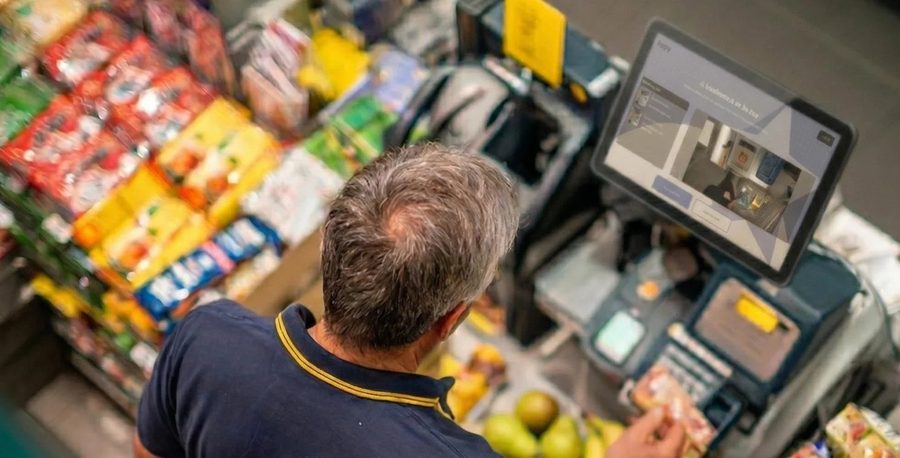
At that grocer, this is now how the prepared foods counters work, in hundreds of stores. A camera above the scale recognises the item as it is weighed. When the system is sure, it selects the item itself and the team member just prints. That happens on more than a third of labels. When it isn't sure, it shows a short list and the team member picks. Either way, nobody has to find a code in a long menu, and nobody has to remember to check afterwards.
The person stays in the loop. Recognition has stayed above 90 percent every month for the past two years. The difference is that the check is no longer an extra task to remember. It is part of something the team member does anyway.
Responsibility for the label still sits with the store team, and it should. But the prepared foods lead at the same grocer, who used to see around 45 mislabelling incidents a week, told us that in the six months after the system went in, she saw two.
What we learned along the way
An automatic check still depends on people, just in a different way.
When we started a pilot in the same grocer's bakery department, half of the first images were unusable. Team members were putting gloves, clipboards and tools on the scale along with the product. After one round of feedback with the store teams, only 6 percent were. It is still something we keep an eye on.
That is the real difference. The manual rule asked people to do a whole extra task. The system asks them to put the product on the scale properly. A small ask, inside the work rather than next to it, is an ask people keep.
If you are responsible for food safety in stores, three questions are worth asking
- When does the check happen, before the label prints or after? Any check that happens after asks people to undo something already done.
- What share of items is actually checked? Not by the policy. By what happens on a Saturday at noon.
- What happens when nobody has time? If the answer is nothing, the check only exists on paper.